If you are wondering what types of video a manufacturer should make, there are 12 worth considering:
Factory tours, product demonstrations, process films, technical explainers, quality and compliance videos, certification films, recruitment videos, trade-show content, case studies, brand films, safety and training videos, and automation and robotics films. The right choice depends on the job you need the video to do.
If you’re not sure where to start, book a 15-minute discovery call with Square Daisy and we can talk it through.
What types of video should a manufacturer make?
There is a temptation with manufacturing video to start with the obvious question: what would look good on camera?
That is understandable. Manufacturing and engineering can be fantastic to film. Production lines move, robots do clever things, CNC machines cut with ridiculous precision and, if you’re lucky, somebody starts grinding something and you get sparks everywhere. But none of that tells you what video you actually need.
A better starting point is the commercial problem. Are you trying to reassure a procurement team that you have the capability to deliver? Explain a technically complex product? Demonstrate a process that is difficult to put into words? Recruit skilled engineers? Train operators consistently? Or get somebody to stop at your stand at an exhibition?
We have worked with engineering, industrial and manufacturing businesses for many years, across everything from spring technology and fibre-optic products to robotics, automation and specialist production facilities. That experience has taught us that industrial video works best when the people making it understand that the factory is not simply a nice-looking backdrop. The process, machinery, people, tolerances, quality controls and technical detail are often the evidence a buyer actually needs to see.
So, rather than starting with cameras, start with the job.
1. Factory tour videos
A factory tour gives prospective customers access to your facility without requiring them to get in a car, put on safety boots and spend half a day visiting you. It can show the scale of the operation, machinery, workflow, people, cleanliness, organisation and the care being taken throughout production.
That makes it particularly useful early in a B2B buying process or as part of a tender. If two suppliers make similar claims on paper, seeing the actual facility can make one considerably easier to trust. We have used this approach with manufacturers including Springtech, where we captured the production environment, equipment, processes and operational workflow while working around a live facility.
If you are weighing up what to show, how much operational detail to include and how to protect commercially sensitive areas, read our guide to factory tour video production.
2. Product demonstration videos
Some products are difficult to appreciate from a specification sheet and a handful of photographs. A product demonstration can show scale, movement, build quality, operation and, most importantly, what the product actually does for the person buying or using it.
For Alker, for example, we created a series of product videos filmed at its production site, combining factory footage, voiceover and supporting material to explain features, benefits and real-world applications. The resulting films were designed to support both sales conversations and customer onboarding.
The trick is not to turn the video into somebody reading the datasheet aloud. Technical specifications matter, but buyers also need to understand why those specifications matter.
For a closer look at how product demonstration videos can support engineering and manufacturing buyers, including sales conversations, procurement submissions and distributor activity, read our guide to product demonstration videos.
3. How-it-is-made and process videos
If your process is part of your competitive advantage, show it.
A process film can follow a product from raw material through machining, forming, assembly, finishing, inspection and dispatch, depending on what you manufacture. It can also concentrate on one particularly important stage where your expertise, equipment or quality control separates you from a competitor.
This is where a little engineering detail helps rather than hurts. Showing a machine cycling is one thing; explaining what is being controlled, measured or achieved at that stage gives the footage a reason to exist. The audience doesn’t need an engineering degree, but neither should we assume they are uninterested in how things work.
4. Technical explainer videos
Engineering businesses regularly have a problem that other sectors would love to have: they have something genuinely clever to talk about. Unfortunately, clever things are often difficult to explain.
A technical explainer takes the complexity and makes it understandable without dumbing it down. Live action might show the equipment itself, while animation can reveal a process occurring inside it, demonstrate a flow that cannot be seen, separate components, illustrate data or show what changes at different stages of operation.
We used a combination of filmed content and animation for the Institute of Spring Technology, producing more than 50 short videos covering subjects including spring physics, design, manufacturing, materials, testing and failure. Animation allowed us to explain elements of spring technology visually where filming alone couldn’t do the job.
5. Quality and compliance videos
If a buyer is considering putting a significant contract through your facility, they will want to know what happens when nobody from sales is standing beside them.
How is quality controlled? What is inspected? What gets measured? How are components handled? What procedures reduce the risk of something going wrong?
A quality and compliance video can make those processes visible. Rather than simply saying that quality is important, you can show inspection equipment, testing, traceability, documented procedures and the people responsible for maintaining standards. Used appropriately in procurement and tender activity, that gives the buyer evidence rather than another paragraph of claims.
6. Certification videos
Certification can be hugely important within manufacturing and engineering, but a row of logos at the bottom of a website does not necessarily tell a customer very much.
Video gives you an opportunity to explain what a relevant certification means in practice: which processes it governs, how standards are maintained and why any of that matters to the customer. This doesn’t need to become a three-minute lecture about an ISO standard. The point is to translate certification from something you have into evidence of how you operate.
These films can work particularly well alongside quality, compliance and tender material, where reducing perceived supplier risk is part of the job.
7. Recruitment and employer-brand videos
Manufacturers don’t only compete for contracts. They compete for people.
If you are trying to recruit engineers, technicians, apprentices, operators or experienced production staff, candidates want to know what they are walking into. A recruitment film can show the working environment, equipment, team, training, progression and the people they would actually work alongside. Our guide to engineering recruitment videos explains how this approach helps employers give specialist candidates a clearer view before they apply.
It can also qualify candidates. Somebody who has already seen the environment and understood the role arrives at the application or interview with a much clearer picture of the business. For companies recruiting specialist skills, that can be far more useful than another job advert containing the words “exciting opportunity”.
8. Trade-show and exhibition videos
Manufacturers spend serious money exhibiting, so the screen on the stand should probably do more than display a corporate film nobody can hear.
Exhibition halls are noisy. A film that relies heavily on interviews or voiceover can become almost useless once it is competing with hundreds of conversations and the stand next door. For engineering equipment and other visual products, strong live-action footage combined with typography, motion graphics and motion tracking can communicate the important information without relying on sound.
It is also worth planning beyond the exhibition. An event-specific edit can be designed to loop silently on the stand, while another version from the same material can use voiceover, interviews or a different structure for your website, sales team and LinkedIn afterwards. One production budget then has a much longer working life.
9. Manufacturing case study videos
If you say your product improves throughput, reduces downtime, cuts waste or solves a production problem, a prospective customer is entitled to ask: where has it actually done that? That is where a good case study earns its keep.
Rather than making your sales team do all the talking, put the customer, application and outcome at the centre. Show the equipment or process in the environment where it is being used, explain the original problem, and let the customer describe what changed.
For technical B2B purchases where several people may influence the decision, a credible customer story can provide useful evidence for the person internally trying to get the purchase approved.
10. Brand films
A manufacturing brand film should not be three minutes of slow-motion machinery accompanied by dramatic music and phrases about “passion for excellence”.
There is nothing wrong with making manufacturing look impressive – it often is impressive – but the film still needs to tell a prospective customer something useful.
A good brand film can bring together your capability, people, facility, history, technical expertise and approach to customers. It gives somebody who has never visited you a proper feel for the business behind the website. For an established manufacturer, that can be especially valuable when selling into new markets or competing for larger contracts where confidence in the supplier matters almost as much as the product.
11. Safety and training videos
Manufacturing training has to be clear, repeatable and practical. Whether the subject is equipment operation, onboarding, PPE, a production procedure, maintenance or health and safety, relying on different people to explain the same process repeatedly inevitably introduces variation.
Video allows the correct procedure to be demonstrated consistently and revisited when needed. It can combine real equipment with close-up footage, graphics, labels, step-by-step instructions and animation where something is difficult or unsafe to demonstrate physically.
There is a straightforward commercial argument as well. If a video reduces repeated trainer time, prevents avoidable mistakes or helps people reach competence faster, its return can often be assessed in saved time and reduced errors rather than marketing metrics.
12. Automation and robotics videos
Automation is made for video because movement is often central to understanding the system. Cobots, robot cells, conveyors, machine vision, automated handling and palletising are far easier to appreciate when you can see the sequence happening.
But filming the robot is only half the opportunity.
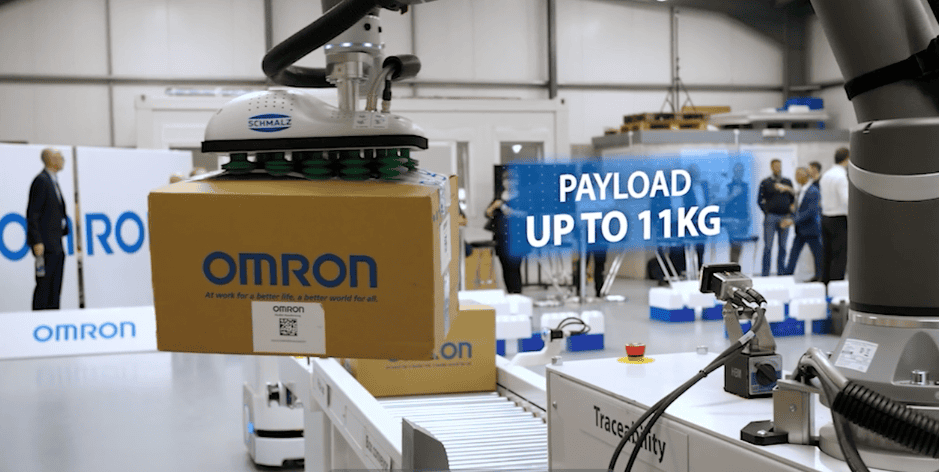
We have worked with Omron over a number of projects, including filming its Flexible Manufacturing Roadshow. The demonstration involved an autonomous factory-floor setup with multiple moving elements, so we used a gimbal-mounted camera to follow collaborative robots and a GoPro for an overhead view. We then used camera tracking, motion tracking and rotoscoping in post-production to bring the performance data and technical information into the footage itself.
And that brings us to something that deserves a section of its own.
How do you show a technical product or process that the camera can’t see?
This is one of the most interesting areas of modern industrial video production.
A camera is very good at showing what is physically in front of it. It is less useful when the important part is happening inside a machine, behind a panel, through a sensor, within software or at a scale that cannot easily be seen.
That is where advanced post-production can completely change what the video is capable of explaining.
Motion tracking allows us to follow a moving object within real footage and attach information to it. Imagine a robot moving through a cell while a graphic stays attached to the relevant component, identifying a sensor, payload, measurement or performance figure as the machine operates. We used exactly this kind of approach with Omron, attaching animated information to moving robots so viewers could connect the technical detail directly with what they were watching.
Rotoscoping goes further by allowing part of the footage to be isolated from its surroundings, effectively creating a precise moving mask around a person, product or component. Once separated, graphics and effects can be layered in front of or behind that object. Used well, this can help draw attention to a particular part of a machine or make an explanation feel integrated into the real environment rather than simply putting some text over the top of the picture.
Then there are motion graphics and animation. These can visualise data, process flows, internal components, software, signals and sequences that simply don’t exist in a form a camera can capture.
For engineering and manufacturing businesses, this combination is enormously useful. You retain the credibility of showing the real machine, real factory or real product, but you are no longer restricted to what the lens can physically see.
See how we use motion tracking, rotoscoping and advanced post-production.
Some other Questions our clients across Manufacturing and Engineering often ask us:
How does video help win engineering contracts and tenders?
A good manufacturing video will not rescue a bad tender. What it can do is make your evidence considerably easier to understand.
Think about the questions sitting behind a procurement decision. Can these people actually make what we need? Do they have the equipment? Is the facility credible? Do they understand our application? Can they maintain the quality? Have they solved something similar before?
A factory film can establish capability. A process video can demonstrate how you work. A case study provides third-party evidence. A technical explainer helps non-engineers on the buying team understand the proposition. A quality video can reduce concerns around risk.
That matters because complex B2B purchases are rarely decided by one person. The engineer who understands your technical advantage may still need to explain it to procurement, operations or a senior decision-maker. Good video gives that internal champion something useful to pass around rather than expecting them to make your argument for you.
How to choose the right manufacturing video type
The simplest way to choose is to forget the format initially and decide what needs to happen next.
- If you are trying to win a tender or establish supplier credibility, start with factory capability, quality and compliance, case studies and technical explainers.
- If you are launching a product, product demonstration, process, technical explainer and animation are likely to be more useful.
- If you are selling machinery or automation, show it working, then use motion tracking, rotoscoping and graphics to explain the features, functionality and data that the camera alone cannot reveal.
- If you are recruiting engineers or production staff, show the actual environment, people and work rather than trying to describe the culture in a job advert.
- And if you are exhibiting, design for the exhibition first: visual, understandable without sound and capable of being picked up halfway through. Then plan additional edits so the same production continues earning its keep afterwards.
That last point applies to almost every type on this page. One filming day does not have to mean one video. With proper planning, the same shoot can generate a main film, product edits, process content, recruitment material, exhibition versions and shorter clips for LinkedIn or sales follow-up. Springtech is a good example: because the filming setup was already in place, additional material was captured for a separate promotional asset with minimal extra operational disruption.
How much does a manufacturing video cost?
There isn’t a sensible single price for a manufacturing video because the production requirements vary enormously. A straightforward product demonstration filmed in one location is a very different job from several days inside a live facility involving multiple processes, interviews, specialist access, animation, motion tracking and dozens of final assets.
The useful question is therefore not simply what does a video cost? It is what content do we need, and how much useful material can we create from the production investment?
Planning makes a significant difference here. If the crew is already inside the factory, it may be possible to capture material for several purposes rather than commissioning separate shoots later. The IST project is a good example of the scale this can reach: filmed content gathered over several days and two locations was combined with animation to produce more than 50 individual videos for education, marketing, LinkedIn, YouTube and events.
We scope manufacturing projects around the objective, locations, filming requirements, post-production and number of outputs rather than pretending every factory or engineering business needs the same package.
Good manufacturing video understands the factory as well as the camera
We have spent years filming in manufacturing, engineering and technical environments, from specialist production facilities and spring technology through to fibre-optic products, robotics and automated manufacturing systems. That matters because these shoots have practical realities: live production cannot always stop because a camera crew has arrived; machinery may have a specific cycle you need to capture; PPE and site rules matter; and the most visually dramatic shot is not necessarily the shot that explains the process.
The creative side still matters enormously. Beautiful cinematography, lighting, sound design and editing make people want to watch. But in technical industries, the clever part is often knowing what needs to be shown, what needs to be explained and when filming needs help from animation, motion graphics, tracking or rotoscoping.
Ultimately, the best manufacturing video types are the ones that make a commercial job easier: helping a buyer understand your capability, helping an engineer explain your product internally, giving procurement more confidence, attracting the right people or making technical information considerably easier to grasp.
If you’re considering video for an engineering, industrial or manufacturing business, take a look at our Engineering & Manufacturing video production work. Tell us what you’re trying to achieve and we’ll scope the right approach rather than simply suggesting that you “make a video”.
If you’re not sure where to start, or if you have a very clear plan of what you;’d like to do, why not start by booking a 15 minute discovery call with our team and go from there – it’s just 15 minutes and you will definitely come away with at least a few insights that you’ll find useful at the very least.