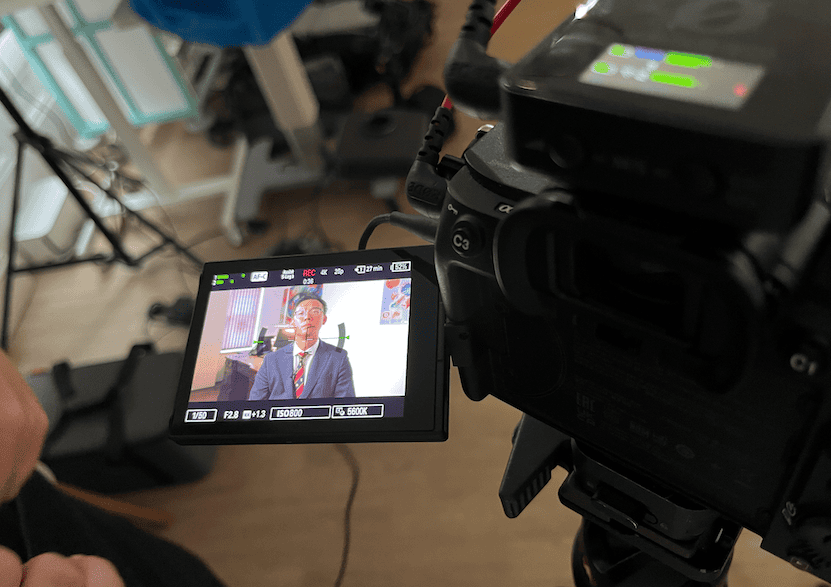
A patient education video explains a condition, treatment, procedure, medication or aspect of care in a way patients can understand before, during or after an appointment. Done properly, it helps people arrive better informed and, where appropriate, reassured about what happens next. For healthcare providers, it can also make important information consistent, accessible and available whenever patients need it.
If you are considering patient-facing video and want to discuss the right approach, you can speak to us at Square Daisy about your project.
What is a patient education video?
At its simplest, a patient education video takes information that normally has to be explained by a clinician, consultant or healthcare team and turns it into something patients can watch and understand.
That sounds straightforward, but healthcare communication has an unusual challenge. The person explaining the subject may have discussed the same procedure hundreds of times. The person watching might have heard its name for the first time ten minutes ago. They may also be anxious, uncomfortable or worried about what the information means for them.
A good patient information video has to bridge that gap without becoming patronising. It needs enough clinical detail to be useful and credible, but the language, pace and visuals should make sense to somebody without medical training.
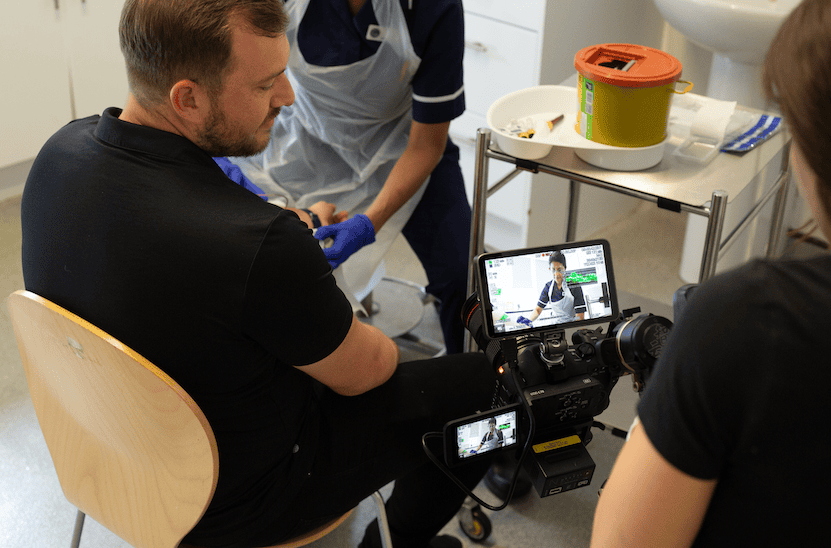
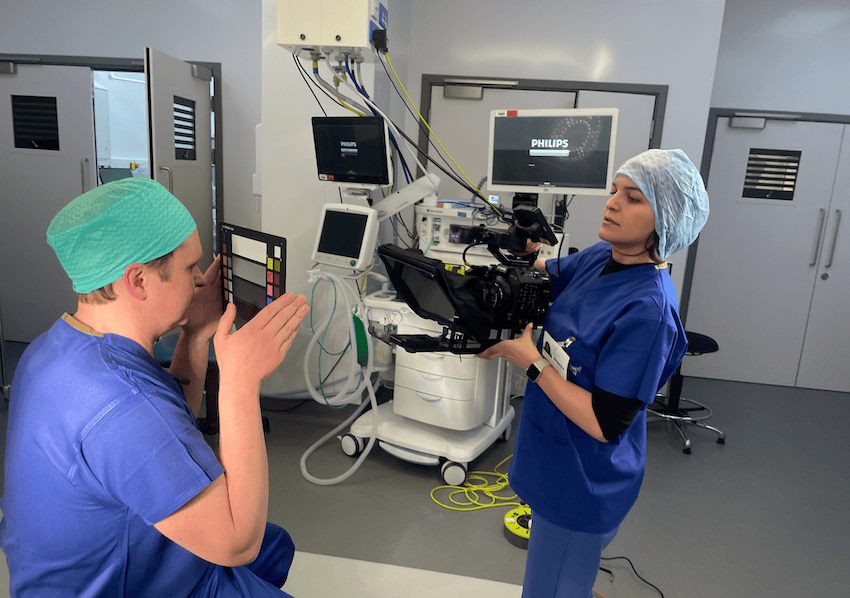
We have been producing healthcare content for many years across private clinics, consultants, diagnostics, fertility, urology, physiotherapy and other specialist services. That has included filming in clinics, radiology departments and operating theatres, as well as producing patient FAQs, procedure videos, instructions, consultant-led explainers and larger libraries of educational content. Our work with The Forbury Clinic, for example, resulted in more than 30 videos filmed across two sites.
The scale matters because healthcare video is rarely just about making something look polished. You have to understand the environment, the audience and what the patient actually needs from the information.
When should healthcare providers use patient education videos?
One of the clearest uses is before a procedure. Patients can be shown what will happen, how to prepare, what equipment they may encounter and what to expect afterwards. That does not replace the conversation with their clinical team, but it can give them a useful reference once they have left the consultation room.
We did exactly this with Berkshire Imaging, creating procedure content designed to help patients understand what to expect from their appointment. For somebody approaching an unfamiliar diagnostic procedure, being able to see the environment and understand the sequence beforehand can make the experience feel much less unknown.
Condition and treatment explainers are another obvious application. A consultant might explain symptoms, diagnostic pathways, treatment options or frequently asked questions, while graphics or animation can help with the parts that are difficult to demonstrate physically.
Medication and aftercare instructions can also benefit from video, particularly where a patient needs to follow a sequence correctly at home. Our work for Uromune has included both patient FAQ content and a patient instruction video, giving patients information they can return to rather than expecting them to remember everything from a single conversation.
The same principle applies when a service changes. If patients need to understand a new pathway, location, booking process or way of accessing care, a short, clear video can explain what has changed and what they need to do.
How do you make health information accessible and clear?
The first rule is surprisingly simple: speak like a human being.
Clinical terminology sometimes has to be used because it is the correct terminology. The answer is not to remove every medical term; it is to explain unfamiliar language when it appears. If a twelve-year-old could follow the basic argument, you are probably heading in the right direction.
It also helps to break information into sensible sections. A patient preparing for a procedure may want to know why they are having it, how to prepare, what happens when they arrive, what the procedure involves, how long it takes and what happens afterwards. Answering those questions in that order is much easier to follow than asking a clinician to deliver everything they know about the subject in one take.
Accessibility needs to be considered at this stage too, rather than bolted on once the edit is finished. That means thinking about WCAG accessibility (Web Content Accessibility Guidelines), subtitles, BSL where appropriate, audio description and the clarity of on-screen text and graphics. Our guide to making video content accessible looks at this in more detail.
Should patient videos have subtitles and BSL?
Subtitles should normally be part of the conversation from the beginning. They support people who are deaf or hard of hearing, but they are also useful for anyone watching without sound or who finds written reinforcement helpful. They are also a very cost effective way to translate your content into different languages if a large segment of your audience has English as a Foreign Language – it is important they have the ability to understand what the procedure or medication is and involves too.
BSL is a separate consideration and should not simply be treated as subtitles in another form. Whether a particular patient video requires a BSL version will depend on its audience, purpose and the accessibility requirements of the provider. The important point is to decide this while planning the project, because accessibility choices can affect framing, graphics, layout and the versions that need to be produced.
The same goes for audio description and other accessibility requirements. A genuinely accessible patient education video is planned around the people who need to use it, rather than producing one master film and assuming everybody can consume it in the same way.
Do patient videos need consent and clinical sign-off?
Yes. Consent and clinical sign-off should be required steps in a patient-facing healthcare video project.
Anyone appearing in the film needs appropriate consent for the intended use of their image and contribution. Where patients are involved, sensitivity is particularly important because the subject may involve personal medical experiences or information they do not want distributed beyond an agreed context. Information governance and the handling of personal or clinical information also need to be considered by the healthcare provider.
Clinical accuracy is equally important. The production company can make information clearer, structure the story and challenge language that an ordinary viewer may struggle to understand, but it should not decide whether medical information is correct. The appropriate clinician or healthcare organisation should review and sign off the clinical content before publication.
There are also situations where showing the real patient is neither necessary nor desirable. In our work with IVF Matters, for example, the sensitive nature of fertility treatment meant the production approach had to communicate the patient experience appropriately without simply assuming that real patients should be put in front of a camera.
That sensitivity extends beyond consent forms. Someone researching fertility treatment, recurrent UTIs, surgery or a new diagnosis may be in a very different frame of mind from somebody watching an ordinary corporate video. Tone, language, imagery and even music need to respect that.
Animation or filmed video: which works better for patients?
Both can work extremely well, and quite often the best answer is a combination.
Filmed video is particularly useful when seeing a real person or environment provides reassurance. A consultant explaining a treatment can establish familiarity before an appointment, while seeing a scanner, consultation room or piece of equipment can remove some of the uncertainty around an unfamiliar procedure.
Animation becomes useful when the important thing cannot easily be filmed. If you need to show what is happening inside the body, explain a biological process, demonstrate how a treatment works or simplify a complicated sequence, medical animation for patients can make the invisible visible. You can see more about that approach through our animated video production and explainer video production services.
Hybrid films can give you the best of both. A consultant can speak directly to the patient while animation, diagrams or motion graphics appear alongside them to explain the clinical detail. The choice should come from what the patient needs to understand, rather than deciding at the outset that everything must be filmed or everything must be animated.
One patient video or a library of useful information?
This is where healthcare organisations can get considerably more value from the production process.
If a consultant is already giving up half a day for filming, there is often little sense in answering one question and packing the cameras away. With proper preparation, that session might cover several patient FAQs, a condition explainer, treatment information and shorter answers for the website or social channels.
We have used that approach extensively in healthcare. Alongside the larger Forbury Clinic project, our work with IVF Matters has included a series of fertility videos produced from one filming day as well as case study content. Dr Rafal Niziol’s project similarly demonstrates how expert knowledge can be captured efficiently as a substantial bank of useful content rather than commissioning isolated videos one at a time.
For a clinic, that can turn video into a patient-information resource rather than another marketing campaign. Patients get clear answers when they need them, clinicians do not have to start every explanation from zero, and the organisation builds a library that can support consultations, websites, appointment communications and ongoing patient education.
How much does a patient information video cost?
There is no useful single price because the scope can vary enormously. A consultant-led FAQ filmed at one clinic is a very different production from a multi-location project involving patients, clinical environments, BSL, several procedures, bespoke medical animation and dozens of finished videos.
The main cost drivers are usually the amount of planning and clinical preparation required, filming time and locations, the number of contributors, accessibility requirements, animation or graphics, and how many final versions need to be delivered.
It is worth looking at cost per useful asset rather than simply cost per filming day. If one properly planned session produces 15 genuinely useful patient videos, the economics are very different from arranging 15 separate productions over the following year.
A sensible quote therefore starts with what patients need to understand, who needs to communicate it and where the finished material will be used. From there, the production can be scoped properly rather than trying to squeeze every healthcare organisation into the same package.
Patient education works when the patient comes first
Healthcare organisations understandably have a lot they want to communicate: clinical expertise, facilities, treatments, technology, outcomes and the credentials of the people providing care. Patient education requires a slightly different starting point.
The useful question is: what does the patient need to understand right now?
Sometimes the answer is what will happen during a scan. Sometimes it is how to use a treatment correctly at home. It might be what their consultant means by an unfamiliar term, what to expect after a procedure or simply what the room will look like when they arrive.
Answer that clearly, make the information accessible, treat consent and clinical accuracy seriously, and use the right combination of people, filming and animation to explain it. The result is content that can be genuinely useful to patients rather than simply another video sitting on a healthcare website.
If you are planning patient information, education or explainer content, you can see more of our experience in healthcare video production or book in a 15 minute discovery call with us to find out how we can create content with you that works.