Conference filming decisions are no longer straightforward.
Hybrid working has changed attendance patterns. Some delegates expect to be in the room. Others expect to join remotely. Sponsors want measurable exposure beyond the venue walls. Speakers want content they can reuse. Organisers want proof of impact.
Capturing and distributing content from a conference is no longer optional for organisations that want reach beyond the room.
That is where professional conference filming and live streaming services come in. The key is understanding what you are booking and why.
Why Conference Filming Is Now a Strategic Decision
Conferences used to be live-only experiences. If you were not in the room, you missed it.
That is no longer the case.
Today, event content feeds:
- Remote delegate access
- Post-event on-demand viewing
- Member-only portals
- Sponsor reporting
- Social media distribution
- Future event marketing
A well-executed conference recording service creates assets you control. Those assets can extend engagement long after the event ends.
When aligned with your wider marketing objectives, conference filming becomes part of building a video marketing system rather than commissioning isolated recordings.
What Professional Conference Filming Covers
A professional conference videographer does far more than record a stage.
On a typical event shoot, coverage may include:
- Keynote speaker sessions
- Panel discussions and Q and A
- Audience reaction shots
- Sponsor moments and branded activations
- Networking and exhibition areas
- Atmosphere footage of the venue
Multi-camera coverage is essential for conferences with multiple speakers or panel formats. A single fixed camera is rarely sufficient. Wide shots, close-ups and reaction angles allow for dynamic editing and professional presentation.
This level of planning is central to effective event videography, especially when content will be reused across multiple platforms.
Conference Live Streaming vs Recorded and Edited Content
One of the most common questions organisers ask is:
What is the difference between conference recording and live streaming?
They serve different objectives.
Recorded and Edited Conference Filming
Recording produces an asset you control. It can be edited for clarity, branded appropriately and repurposed later. It supports:
- On-demand viewing
- Highlight reels
- Speaker clips for LinkedIn
- Gated content for members
- Future promotional campaigns
Put simply, it allows refinement after the event.
Conference Live Streaming
Live streaming conference UK services create immediacy and reach. Remote delegates can watch in real time. Hybrid attendance becomes possible.
However, live streaming requires more technical planning. Encoding, bandwidth management, switching and monitoring must all happen simultaneously.
Latency, streaming platform choice and redundancy systems need to be considered in advance.
Often, both approaches should run together. Live streaming serves the moment. Recorded content serves the long term.
A professional conference filming company will advise based on your audience, objectives and technical environment.
The Technical Requirements You Should Expect
Technical planning is where conference shoots succeed or fail.
Multi-Camera Setups
For large conference rooms or panel sessions, multiple cameras are fundamental. This allows switching between speakers, audience shots and wide context views.
Without multi-camera coverage, editing options are limited and production quality suffers.
Audio: The Most Common Failure Point
Audio is the most common point of failure in conference filming.
A crew that does not use dedicated directional microphones and monitor audio in real time will produce unusable recordings.
Professional setups typically involve:
- Direct feeds from venue sound desks
- Backup microphones
- Directional microphones for panelists
- Real-time monitoring throughout the session
Sound clarity matters more than visual polish. If delegates cannot hear clearly, the recording loses value.
Switching and Encoding
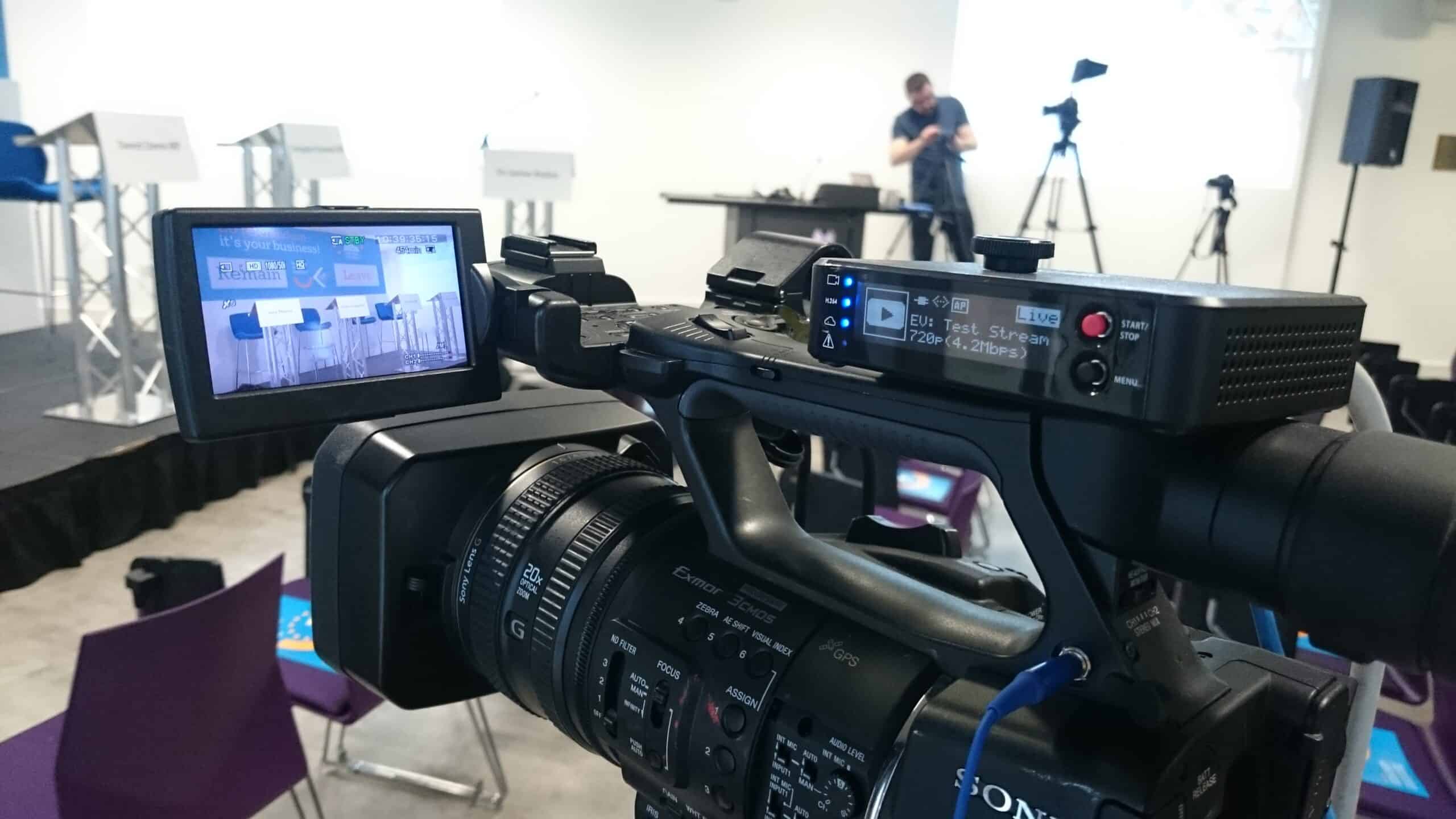
For conference live streaming, a live switcher is used to manage camera feeds in real time. Encoders convert the signal for streaming platforms. Backup contingencies are critical in case of connectivity issues.
Hybrid event filming adds another layer of complexity, which requires additional crew oversight.
What Is Hybrid Event Filming?
Hybrid event filming means delivering for two audiences simultaneously: those in the room and those attending remotely. This requires different thinking.
Camera operators focus on capturing strong visuals for the recorded version. Meanwhile, a dedicated streaming producer manages live output, monitors quality and responds to technical issues.
Hybrid events require a dedicated streaming producer, separate from camera operators. Conflating these roles leads to quality failures on one or both outputs.
Directing, switching and quality control must account for both experiences at once.
When handled properly, hybrid event filming extends reach without compromising the in-room experience.
What Happens After the Conference?
Conference filming does not end when the last speaker leaves the stage.
Edited highlights should ideally be turned around within days of the event. The subject matter is still current. The audience’s attention is still engaged.
Post-event deliverables may include:
- An extended highlight film
- Individual speaker clips
- Sponsor-specific edits
- Social cuts for paid campaigns
- Full session recordings
Those shorter clips can feed into broader strategies, including social media advert video production to extend campaign reach.
Exhibition and conference footage can also evolve into long-term marketing assets, as demonstrated in projects such as transforming a single expo into evergreen promotional content.
What to Prepare Before the Filming Crew Arrives
Preparation makes the difference between a smooth conference filming experience and a reactive one.
Organisers should provide:
- A detailed run-of-show document
- Venue contact details and AV specifications
- Room layouts and stage plans
- Speaker lists and briefing notes
- Sponsor obligations relating to footage
Clear communication with the conference filming company in advance ensures efficient setup and minimal disruption on the day.
What to Ask a Conference Filming Company Before Booking
If you are comparing providers, ask:
- How will cameras be positioned?
- How will audio be captured and monitored?
- Do you provide conference live streaming in-house?
- Who manages the live switch?
- What backup contingencies are in place?
- What is your turnaround time for edited highlights?
- Do you operate with an in-house team or freelancers?
Square Daisy operates with an in-house team. For conference shoots, this means consistent equipment, clear communication and defined accountability throughout the project.
How Much Notice Does a Conference Filming Company Need?
Larger conferences should ideally be booked weeks or months in advance.
This allows time for:
- Technical planning
- Site visits
- Coordination with venue AV teams
- Scheduling crew appropriately
Last-minute bookings increase risk and limit preparation.
Conference Filming as Part of a Broader Strategy
Conference filming and live streaming should not exist in isolation.
They should connect to broader efforts, including event video production for conferences and exhibitions and ongoing content strategies.
When structured properly, conference filming supports marketing, sales, sponsor retention and future event growth.
Building Ongoing Value from Conference Filming
Live streaming and conference filming serve different objectives. Recording produces an asset you control. Live streaming creates immediacy and reach but requires greater technical planning.
Multi-camera coverage protects production quality. Dedicated audio planning protects usability. Hybrid events require specialist roles to avoid compromise.
Handled strategically, conference filming becomes more than documentation. It becomes infrastructure for ongoing engagement.
If you are planning an upcoming conference and want clarity on filming, live streaming or hybrid delivery, get in touch to discuss your event objectives.