Corporate video has a creativity problem. Not because businesses lack talented people. Not because agencies lack ideas. And certainly not because audiences have stopped paying attention to video.
The problem is that much of today’s corporate video looks and feels remarkably similar.
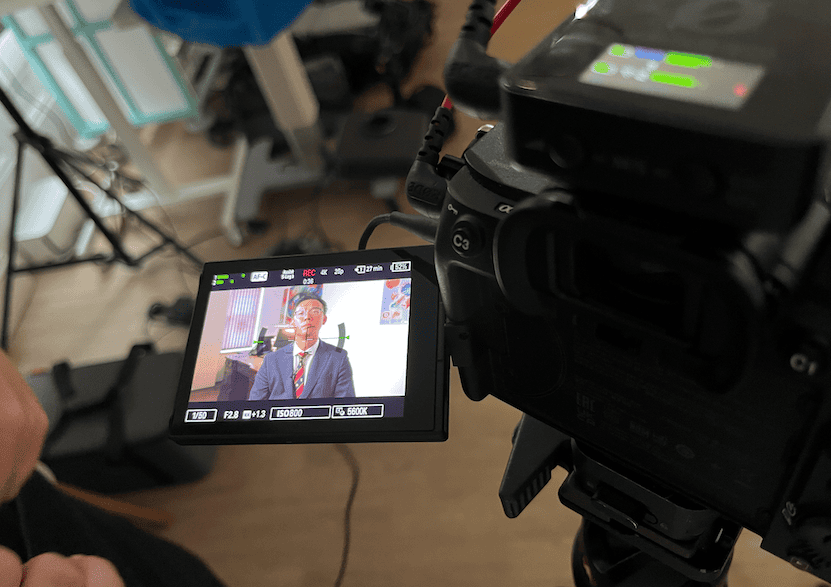
A leadership interview filmed in an office. Slow-motion footage of people walking through corridors. Generic music building towards an inspirational ending. A carefully scripted message that sounds polished but could belong to almost any company in the sector.
Watch enough corporate videos and a pattern starts to emerge. Different logos. Different industries. Different people. Yet somehow the same film. The irony is that most organisations invest in video because they want to stand out. Yet the final result often makes them look more like everyone else.
The question is why.
The Fear Behind Corporate Video
Most corporate videos don’t become generic by accident. They become generic because businesses are trying to avoid risk.
Large organisations are understandably cautious about communication. Multiple stakeholders are involved. Marketing teams need approval. Leadership teams want reassurance. Legal departments sometimes need to review messaging. The result is often a process designed to remove anything that feels controversial, unusual or unexpected.
Unfortunately, those are often the very things that make content memorable. Every round of feedback tends to smooth the edges. A strong opinion becomes a balanced statement. A distinctive story becomes a broad message. A bold creative idea becomes something “safer.”
Eventually, the video reaches a point where nobody dislikes it. The problem is that nobody remembers it either.
In trying to avoid criticism, many businesses unintentionally remove the characteristics that make communication effective in the first place.
Safe Messaging Creates Similar Brands
One of the most common phrases in corporate marketing is, “We don’t want to alienate anyone.” On the surface, that sounds sensible. In practice, it often creates messaging so broad that it struggles to connect with anyone in particular.
Many corporate videos end up relying on the same language because organisations are trying to communicate universal strengths. They talk about quality, innovation, expertise, service and customer focus. While these things may be true, they are rarely unique.
The challenge is that differentiation doesn’t come from saying the same things more clearly than your competitors. It comes from saying something they wouldn’t say.
The brands that stand out are usually willing to reveal more of their personality, perspective and point of view. They make decisions about what they want to be known for and communicate those ideas consistently.
That doesn’t mean being controversial for the sake of it. It means having enough confidence to sound like yourself rather than a collection of industry clichés.
Because if every competitor describes themselves using the same language, buyers are left with very little reason to choose one over another.
B2B Still Needs Storytelling
There is a persistent misconception that storytelling is primarily a consumer marketing tool. The logic goes something like this: B2C buyers are emotional, while B2B buyers are rational. Anyone who has spent time around real buying decisions knows that isn’t true. Business buyers may be making commercial decisions, but they are still human beings. They still respond to curiosity, tension, emotion and narrative. The difference is that B2B storytelling often looks different from consumer advertising.
It isn’t necessarily about humour or entertainment. It’s about creating enough interest to hold attention and enough relevance to make people care. Every strong story contains some form of tension. There is a challenge, a risk, a problem or an opportunity that needs to be resolved. Yet many corporate videos remove tension entirely. Everything is positive. Everything is successful. Everything is presented as though no challenges have ever existed. While that approach may feel reassuring, it often makes content less believable.
Some of the most effective corporate videos acknowledge difficulties openly. They discuss industry challenges, customer frustrations or obstacles that needed to be overcome. By introducing genuine tension, they create a reason for people to keep watching. Without tension, there is no story. Without story, there is often very little engagement.
Authenticity Is More Powerful Than Polish
For years, corporate video production has focused heavily on polish. Perfect lighting. Perfect scripts. Perfect delivery. Those things still matter. Nobody is suggesting businesses should abandon professional standards.
However, audiences have become increasingly good at recognising when communication feels overly manufactured.
The most effective business content today often feels more human than corporate. That doesn’t mean poor production quality. It means allowing real expertise, real opinions and real personalities to come through.
Some of the strongest videos feature people speaking naturally rather than reciting approved messaging. Others focus on customer experiences rather than company claims. Many succeed because they prioritise clarity and honesty over perfection.
The goal should not be to look flawless. The goal should be to feel credible. When viewers believe they are hearing from real people rather than a carefully managed brand voice, trust becomes easier to build. And trust remains one of the most valuable outcomes any corporate video can achieve.
The Cost of Playing It Safe
There is a commercial consequence to all of this. When every corporate video looks the same, buyers stop paying attention.
More importantly, businesses lose opportunities to communicate what genuinely makes them different.
Video is one of the few marketing tools capable of showing personality, expertise, culture and perspective simultaneously. It allows organisations to demonstrate who they are rather than simply describe themselves. When that opportunity is reduced to generic visuals and predictable messaging, much of the potential value disappears.
The investment may still produce content. It just won’t necessarily produce distinction. And in competitive markets, distinction is often where value is created.
A Simple Test
If you’re evaluating your current corporate video, there is a simple question worth asking: “Could one of our competitors replace our logo with theirs and still use the video?”
If the answer is yes, you don’t have a video problem. You have a brand differentiation problem.
The most effective corporate videos don’t simply communicate what a business does. They communicate something distinctive about how it thinks, how it operates and why it matters. That requires a degree of confidence. Confidence to sound different. Confidence to tell real stories. Confidence to move beyond the familiar formulas that dominate so much corporate content.
Because standing out rarely comes from being louder than everyone else. More often, it comes from having the courage to stop sounding exactly like them.