We don’t have an information problem anymore. We have an attention problem.
There was a time when simply having information gave businesses an advantage. If you could explain your product more clearly than your competitors, publish useful content or produce a professional video, you stood a good chance of being noticed. That world has changed.
Today, information is abundant. Every business has a blog. Every company has a LinkedIn strategy. AI can generate articles, emails and social posts in minutes, making it easier than ever to produce content at scale. The problem isn’t that businesses have nothing to say; it’s that everyone is saying something, all at once. Our customers haven’t become less interested. They’ve simply become better at filtering out anything that doesn’t immediately feel relevant.
That’s the environment modern marketing has to work within. Attention has become a scarce resource, and trust is even harder to earn. The organisations that understand this aren’t necessarily producing more content than everyone else. They’re producing content that people actually choose to spend time with.
Storytelling is one of the few things that still cuts through the noise.
The attention economy has changed the rules
Marketers often talk about the attention economy as though it’s a new concept, but we’ve always traded in attention. What’s different today is the sheer volume of competition. Every notification, every email, every social platform and every algorithm is competing for the same finite amount of human focus.
The natural response has been to produce more. More videos, more blogs, more campaigns, more posts. Yet volume doesn’t automatically create visibility. In many cases, it simply adds to the noise.
That’s why businesses that measure success purely by how much content they publish often find themselves disappointed. More activity doesn’t necessarily lead to more engagement, stronger relationships or better commercial outcomes. If anything, it can have the opposite effect, because audiences quickly learn to ignore content that feels generic or self-serving.
The question isn’t how much content you can create. It’s whether it’s worth someone’s attention in the first place.
Information isn’t enough
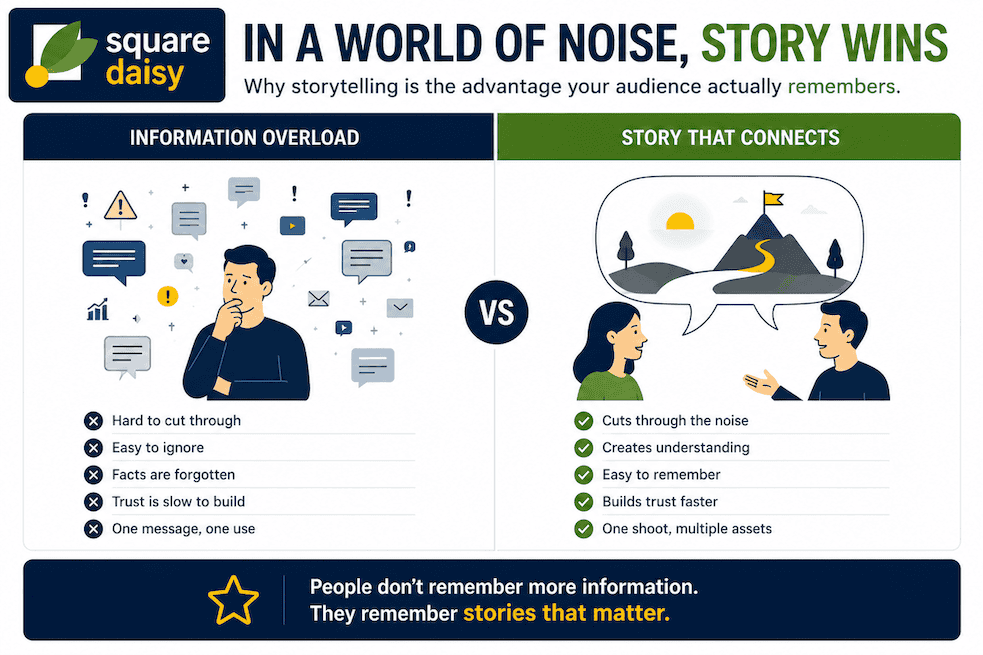
Most B2B marketing is built around information. We explain what we do, how we do it, why we’re different and why our solution is better than everyone else’s. Those things matter, but they rarely make us memorable.
Think about the last business presentation you sat through. You probably heard plenty of facts, figures and bullet points. A week later, how much of it could you honestly recall?
Now think about the last customer story that genuinely resonated with you. Chances are you remember the challenge they faced, what changed and the outcome they achieved. You probably remember it because your brain wasn’t trying to memorise information; it was following a narrative.
Stories give information context. They allow people to understand not just what happened, but why it mattered. That’s how we naturally process information, whether we’re choosing a new supplier or deciding what film to watch on a Friday evening.
B2B buyers are still people
One of the strangest habits in marketing is the way we separate B2B and B2C as though they’re governed by completely different rules. Businesses don’t buy products or services. People do.
A marketing director doesn’t stop being human when they arrive at work. A procurement manager still wants to feel confident they’ve made the right decision. A managing director still worries about making an expensive mistake.
Of course there are commercial considerations, budgets and procurement processes, but underneath all of that sits a very human question: can I trust these people?
That’s why emotional connection isn’t a consumer marketing concept. It’s a business concept. Trust isn’t built through exaggerated claims or lengthy explanations. It’s built when people recognise themselves in the problems you’re solving and believe you understand the world they’re operating in.
A well-told customer story often achieves that far more effectively than another page explaining your capabilities.
Every good commercial film tells a story
When people hear the word storytelling, they often imagine something cinematic. Dramatic music. Sweeping drone shots. Emotional voiceovers. In reality, commercial storytelling is much simpler than that.
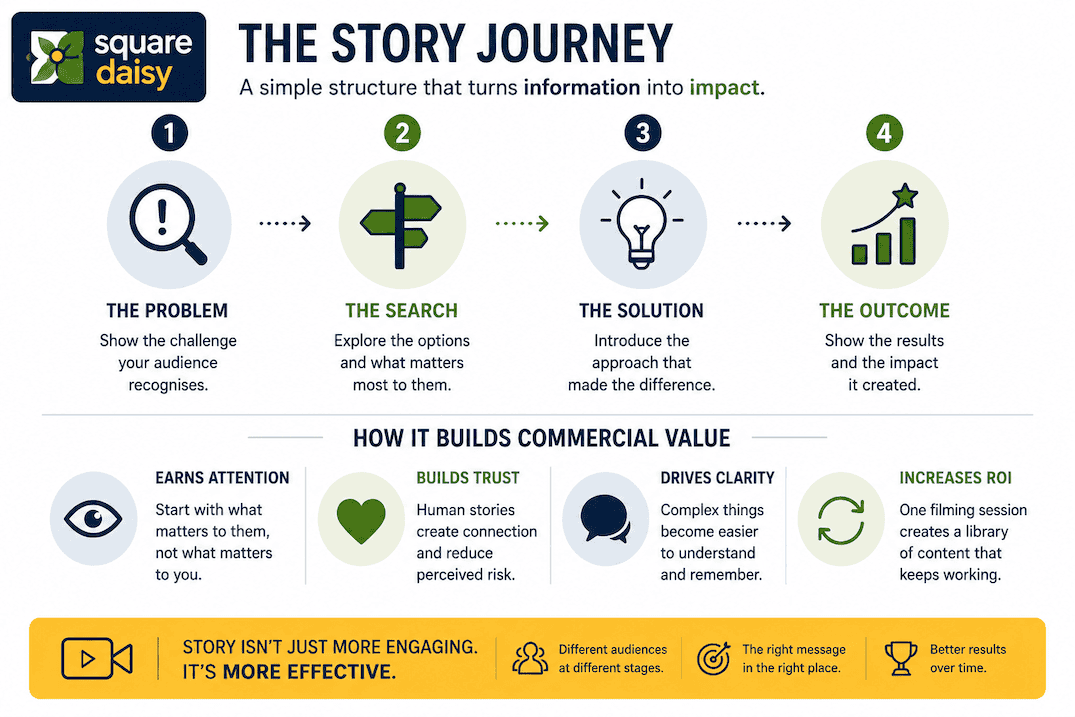
Every effective business film follows a recognisable journey. Someone has a problem worth solving. They look for a better way. They find a solution. Their situation improves.
That doesn’t mean inventing drama where none exists. It means giving your audience a reason to keep watching because they’re following an idea rather than being presented with a list of facts.
One of the most common mistakes in corporate video is trying to include everything. Every service, every award, every statistic and every message competes for attention until none of them stand out. The result is a film that explains a lot but says very little.
A stronger approach is to focus on one story and tell it well. If other questions need answering, create other pieces of content designed to answer them. A single filming day can produce a library of assets, each with its own purpose, rather than relying on one video to do every job. That approach reflects Square Daisy’s wider philosophy of creating structured, multi-asset content rather than one-off productions.
Story creates trust because it feels real
Trust is difficult to manufacture. Audiences are remarkably good at spotting polished marketing that says all the right things without actually revealing anything.
Stories work because they’re grounded in experience. They have people, context and consequences. They allow potential customers to imagine themselves in a similar situation and ask whether the same outcome might be possible for them.
That’s why testimonials remain so powerful. They’re not persuasive because they’re professionally filmed. They’re persuasive because someone independent is sharing an experience that feels believable.
The same principle applies whether you’re producing a brand film, a recruitment campaign or an animated explainer. The format matters far less than whether the audience comes away feeling they understand something more clearly and trust you a little more than they did five minutes earlier.
Earn attention. Reward it. Respect it.
Every piece of marketing asks for something valuable: someone’s time.
That time shouldn’t be taken for granted. If your audience gives you thirty seconds of their attention, they’ve chosen not to spend those thirty seconds somewhere else. That’s a privilege, not an entitlement.
The best content recognises that. It earns attention by addressing something the audience genuinely cares about instead of opening with a long introduction about the business. It rewards attention by providing useful insight rather than repeating obvious marketing messages. And it respects attention by finishing before it outstays its welcome, leaving people feeling their time was well spent.
Those principles sound simple, but they’re surprisingly uncommon. Too much business content is still built around what the company wants to say instead of what the audience wants to understand.
Story will only become more valuable
AI will continue to make content creation faster and cheaper. Businesses will publish more articles, generate more videos and automate more marketing than ever before. None of that is inherently a bad thing, but it does mean that volume is becoming less of a differentiator.
The organisations that stand out over the next few years are unlikely to be the ones producing the most content. They’ll be the ones producing the most meaningful content. The businesses that understand their customers, communicate with clarity and tell stories that reflect genuine experience will always have an advantage over those simply adding more information to an already crowded market.
Storytelling isn’t about being creative for the sake of it. It’s about helping people understand why something matters. In a world where everyone has access to the same tools and the same platforms, that ability to create understanding may become one of the few advantages that can’t be automated away.